Monday, 15 April 2019

Amazon of Africa: Jumia raises $200m despite huge losses

Despite hefty losses, Africa-based and focused Jumia’s ecommerce IPO was a success.
credits: the Crunchbase Daily
Last week the company priced its IPO mid-range, selling 13.5 million shares at $14.50 each, the midpoint of its range. That’s worth just under $200 million. Tack on the 2,0250,000 more shares available to underwriters and the company’s possible total raise grows to $225 million.
And Jumia may raise the full 225 after its IPO was given a rapturous reception. After listing on the New York Stock Exchange, Jumia’s shares closed at $25.46, up 75.6 percent. It has risen further since.
There are two ways to read that result. The first is as a success; Jumia raised hundreds of millions of dollars, floated its shares, and managed a huge first-day gain. And you can read it as a failure; Jumia could have theoretically sold fewer shares at a higher price to raise its capital, lessening dilution of extant shareholders.
But in the IPO hierarchy of results, having a big first-day pop is better than over-pricing shares and seeing your equity quickly slip under its IPO price. So, Jumia had at least a pretty good day, even if you want to (fairly, I’d say) reckon that its IPO was underpriced.
We bring all this to you for two reasons:
  • Jumia’s IPO shows that there is plenty of appetite on U.S. exchanges for high-risk shares in tech companies still losing lots of money;
  • That ecommerce isn’t category non grata among public investors.
The first point is true in Jumia’s case despite being a dramatic example of the trend. As we reported when Jumia filed to go public, it has workable growth but huge losses, measured as a percent of revenue:
The numbers are simple enough. Revenue grew from 94.0 million Euro in 2017 to 130.6 million Euro in 2018. That’s 38.9 percent growth. During the same two periods, however, the firm’s “loss for the year” rose from 165.4 million Euro to 170.4 million Euro.
So, what gives? I would bet a dollar that Jumia’s status as the “Amazon of Africa” has something to do with its success in the face of such deep unprofitably. After all, Amazon famously lost money for years before becoming one of the biggest companies in the world. And as Jumia has a strong presence in Africa, a continent with around 1.2 billion people, it has huge growth potential.
Do its losses matter, then, so long as Jumia is building the continent’s future online shopping, shipping, and last-mile delivery network? Maybe not. At least that appears to be the public investors’ wager.
It’s the same bet that private-market investors made in the company to the tune of hundreds of millions of dollars. Supposedly smart money on both sides of the public-private market divide has proven more than willing to power Jumia. Now it’s up to the company to tighten up its losses and show that it can expand without the crutch of external capital.
But don’t think that we’re only judging Jumia along those lines; most unicorns going public this year are shedding cash faster than is healthy. The whole class of companies will need to curtail costs while still driving growth.

Thursday, 11 April 2019

“The currency of the future is going to be coding,” says Akinwumi Adesina


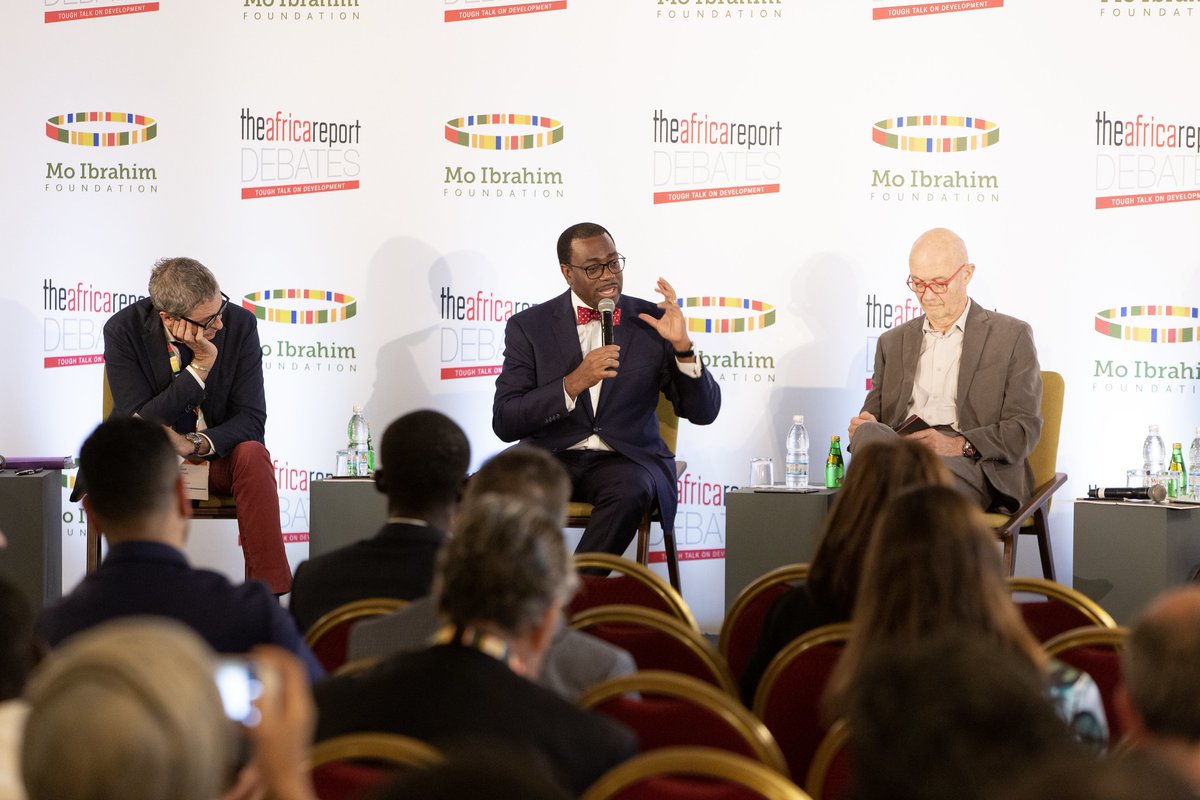
 At the just concluded Ibrahim Governance Weekend by the Mo Ibrahim Foundation, African Development Bank President Akinwumi Adesina, pleaded for Africans to embrace technology, and governments to urgently move away from “investing in the jobs of the past, but rather in the jobs of the future. A future that is just around the corner.”
The former Nigerian Minister of Agriculture addressing a debate entitled: The New Tech Era: Job-killer or Job-creator?organised by The Africa Report and Jeune Afrique as part of the2019 Mo Ibrahim Governance Weekend. 
“The people who control data, will control Africa. Coding must be compulsory, at all levels. The currency of the future is going to be coding,” Adesina said. “Information technology must not be the exclusive privilege of the elite, we must democratize technology,” he added.
Panelists included Pascal Lamy, board Director of the Mo Ibrahim Foundation and past Director-General of the World Trade Organization; Eric Kacou, an Ivorian businessman and co-founder of ESP Solutions; Chioma Agwuegbo, a Nigerian tech specialist and Zyad Liman, publishing director of Afrique Magazine.
In his welcome remarks, Mo Ibrahim urged the panelists to think about ways to address the “tsunami of young people entering the job market.”
In response to that call to action, Kacou insisted on the need for “a change in mindset to move from BBC or Born Before Computers to rethinking education to teach people how to learn and help them solve problems.”
Panelists acknowledged the critical role the tech industry can play in Africa’s economic transformation through the continent’s digitization. However, they agreed on the urgent need to upgrade the skills of the past, to do it fast, and move away from the social fear of technology.
Research has shown that if governments harness the full economic potential of just the internet, Africa could add $300 billion to its GDP by 2025. Also, 70% of all jobs will have an ICT component by 2020.
Opportunities to transform Africa through technology are endless.  In agriculture, drones can monitor crops, Artificial Intelligence can speed varietal selection, and the Internet of the Things can control smart irrigation systems. Block chains can also aid food traceability.
“We must grab the opportunities…We must democratize technology. Africa should prepare itself. Digital technologies, including Artificial intelligence, big data analytics, blockchains, 3D printing, are already upon us,” Adesina concluded.
The three-hour interactive session ended with members of the audience calling for accelerated policy reforms and creating an enabling environment for innovative technology to thrive. The issue of data protection, identity protection and fake news and how to turn population into assets, topped discussions.

Thursday, 17 January 2019

2019 Africa Prize for Engineering Innovation Shortlists in Cape Town

The shortlist for the Africa Prize for Engineering Innovation 2019 has been announced in Cape Town, South Africa, recognising the most promising entrepreneurial engineers from across sub-Saharan Africa. The 16 shortlisted innovations come from six countries, with five female engineers among them.
 
 See the list below
 1.Prof Dele Sanni, 53, an agricultural engineer from Nigeria with 3-D-3-P, a unique industrial dryer that gives Nigerian farmers and producers an affordable, local option for drying feed, sawdust and cereal grains.


 2. Muzalema Mwanza, 34, a civil engineer from Zambia with Baby Delivery Kits, a collection of essential tools to assist midwives in delivering babies at home or in under-resourced clinics across the country.

Lusaka

 3. Collince Oluoch, 27, a self-taught software developer from Kenya with Chanjoplus, an affordable digital tool for health workers to identify, register and track vaccinations, without requiring internet connectivity.

4. Kenneth Guantai, 33, a mechanical engineer from Kenya with Elo-Cart, electrified handcarts that use regenerative energy to ease the load carried by vendors, hospital workers and airport staff.

5.Dr Lukas du Plessis, 46, a mechanical engineer from South Africa, with a hybrid, five-axis machine tool that gives local manufacturers an affordable option for shaping metal, wood and other materials.

 6. James Ochuka, 23, a mechanical engineer from Kenya with JuaKaliSmart, an online portal that connects juakali – artisans of Kenya’s informal manufacturing sector – directly to customers.

 7.Chukwunonso Arinze, 25, a mechanical engineer and physicist from Nigeria with KAOSHI, a foreign exchange market where users swap currencies, eliminating bank charges and long queues.


Abuja
 8.Beth Koigi, 27, a project planner from Kenya with Majik Water, which harvests water from the atmosphere in especially arid areas, and sells affordable and clean water to communities through unmanned ATMs.

9.Neo Hutiri, 30, an electrical engineer from South Africa, with Pelebox Smart Lockers, which dispense chronic medication securely, helping patients in public health systems avoid queues, and easing pressure on clinic staff.

10.Roy Allela, 25, an electronics engineer from Kenya with Sign-IO, a smart glove that translates sign language into speech in real time; to help children with speech and hearing impediments.

 11.George Chege, 27, a biosystems engineer from Kenya with Smart Brooder, a system that automates gas heating on chicken farms, takes the guess-work out of the equation and reduces reliance on coal.

 12. Anne K. Rweyora, 31, an industrial designer from Uganda with Smart Havens Africa, which builds smart, off-grid homes from affordable and sustainable materials, sold to new home owners on a rent-to-own model.

 13. Safiatou Nana, 26, a renewable energy engineer from Burkina Faso with SolarKoodo, an off-grid solar irrigation system for farmers in semi-arid areas with a low water table, aimed at co-operatives with low equipment budgets.

14.Paul Matovu, 29, a forester from Uganda with The Vertical Farm, a farm-in-a-box vertical garden to grow microgreens in urban settings, custom built for users with little space for garden.

15.Dr Obi Igbokwe, 46, a medical doctor from Nigeria with WellNewMe, an online assessment that identifies health risks from user data, to help prevent illnesses like cancer and diabetes.


16. Elizabeth Kperrun, 32, a business graduate from Nigeria with Zenafri, a series of apps that teach toddlers and young children basic numeracy and literacy skills in their native tongue, using local folklore.

The Africa Prize encourages ambitious and talented sub-Saharan African engineers from all disciplines to apply their skills to develop scalable solutions to local challenges, highlighting the importance of engineering as an enabler of improved quality of life and economic development. Crucial commercialisation support is awarded to a shortlist of innovative applicants through an eight-month period of training and mentoring.
Following this period of mentorship, finalists are invited to present at an event held in Africa and a winner is selected to receive £25,000 along with three runners-up, who are each awarded £10,000.
24 Year Old Ugandan won the Africa Prize in 2018
A 24-year-old Ugandan software engineer has won the Africa Prize for Engineering Innovation. Brian Gitta is the first Ugandan to win the prestigious Africa Prize, and the youngest winner to date.
Gitta and his team developed Matibabu, a device which tests for malaria without drawing blood. Matibabu, which means ‘medical centre’ in Swahili, is a low-cost, reusable device that clips onto a patient’s finger, requiring no specialist expertise to operate. The results are available within one minute on a mobile phone that is linked to the device.
The team win the first prize of £25,000. At an awards ceremony in Nairobi, Kenya on 13 June 2018, four finalists from across sub-Saharan Africa delivered presentations, before Africa Prize judges and a live audience voted for the most promising engineering innovation.

The Africa Prize is generously supported by The Shell Centenary Scholarship Fund and the UK Government's Global Challenges Research Fund.

Historical sponsors have included Consolidated Contractors Company, The Foreign and Commonwealth Office's Africa Prosperity Fund, ConocoPhillips and the Mo Ibrahim Foundation.

Wednesday, 2 January 2019

Tony Elumelu Foundation Entrepreneurship Programme to empower the next generation of African entrepreneurs with USD$100 million capital

In business the role luck plays in success and personal achievement is rarely discussed. If luck is mentioned, it is done with slight condescension, and usually dismissed as a product of hard work, not deserving significant attention. While hard work is paramount – and I have written extensively about the importance of working hard – history and my own experiences show that there is often a large element of success that hard work alone can not explain. It is simply not true that “you make your own luck.”
I started my career as a salesman, a copier salesman to be specific, young, hungry, and hardworking, but the reality was that I was just one of thousands of young Nigerian graduates, all eager to succeed. How did I get from there to where I am now? Of course, hard work, resilience, a long-term vision – but also luck.
A year later after earning my Master’s degree in Economics from the University of Lagos, I applied to join a new generation bank, Allstates Trust Bank. The bank’s one-page newspaper advertisement demanded a minimum 2:1-degree, but I applied regardless, submitting a cover letter and filled out application with my 2:2-Economics degree.
By a stroke of luck, my application was reviewed by the Chairman/CEO, a painstaking man who carefully read my cover letter and was drawn to the confidence in my words. “I know I may not have met the qualifying criteria for the advertised roles, but I am intelligent, driven, ambitious and I will make the bank proud. My 2:2 degree does not demonstrate the full extent of my intelligence and ability, and I know I can do so much more.” He read those words and took a chance on me. Though “unqualified”, he decided to throw me a lifeline, an opportunity.
I was invited to join the shortlist, followed by a long series of interviews and even more tests. At the end of a very rigorous process, I received good news – I had a place as an entry level analyst. Even now, I wonder: What if the Founder had not personally gone through my application? What if my application was rejected at the very beginning? What if I never got the opportunity to work at Allstates Trust Bank?
The story continues: within 12 months at the bank, aged 27, I went from analyst to branch manager – the youngest ever bank branch manager at the time. I was hard working, energetic, creative and prioritised getting things done, but it was also good fortune that my bosses Toyin Akin-Johnson and Ebitimi Banigo took notice, and then, believed in me. They took a chance on me by appointing me as branch manager after an incredibly short time in the bank. They recognised in me the raw materials needed to make a good leader and were prepared to invest in me and my ability. My rise to Branch Manager within a short period is a great story but I know in my heart, I was lucky, as well as deserving.
This position of branch manager was a solid platform which launched me into several top leadership roles. When we, a small group of hungry, determined, young outsiders, took over struggling Crystal Bank, it was as a direct result of the preparedness and exposure that we received early from our superiors and mentors. Without the intervention and goodwill of these people in my career, I would not have been prepared as I was to take on far greater roles. These learning opportunities laid the pathway to future achievements. Put simply, I was lucky enough to be identified and trusted so early on in my career, and this put me on a unique road to success. I keep this in mind – it is humbling and also drives much of what I do today.
When I left UBA as Chief Executive Officer (CEO) in 2010 to pursue other interests, I made a vow that through the Tony Elumelu Foundation, I would “institutionalise” luck and democratise access to opportunities for young Africans. I promised to leverage the success I have enjoyed, to spread luck and hope, provide opportunities and to empower the next generation of African entrepreneurs to succeed. Without luck in my early career, I would not be the man that I am today. I am a leader and philanthropist today because I encountered people who gave me a chance early in my career. It has been a lifetime goal to pay this forward in a transformative and impactful way.
Over the past three decades I have spent as a banker, investor, and turnaround expert, I have had the opportunity to meet thousands of entrepreneurs, like me. Many of them young people, with incredible dreams and business ideas but without the experience or the access to mentoring and support required in order to build successful businesses. But most importantly, they have not yet been exposed to the right opportunity.
Our entrepreneurs are hard at work across the continent, identifying gaps in the market for specific products and services, and bridging these gaps with their innovation and ingenuity. Yet, many of these budding entrepreneurs often lack the capital, the networks, the training, the support to take their small business to national or regional scale. All they need is a helping hand, some luck, someone to believe in them and take a chance on them.
This is what the Tony Elumelu Foundation offers: a platform that empowers African entrepreneurs– from business management training, to mentoring, to funding to networking – championing their cause and giving them a global voice to actualise their ambitions. This is precisely why I launched the USD$100 million Tony Elumelu Foundation Entrepreneurship Programme to empower the next generation of African entrepreneurs. Indeed, these may be the next UBAs (United Bank for Africa).
So, when I am asked, “Tony, why are you and your family doing this? What is in it for you?” I smile and recount my own story of luck. Luck is real, it is powerful, and I am committed to spreading it as far as I can. I am a beneficiary of luck, and I am passionate about sharing it across the continent, to all 54 countries.
I want our young aspiring entrepreneurs to apply. I want you to be a part of this global movement for good. I encourage you to be bold enough to let luck find you. There will be 1260 places open from January 1, 2019. Will you be among the lucky ones this year? Take a chance on yourself. Your future may begin today. Apply now at TEFCONNECT.COM

Friday, 29 June 2018

Coca Cola launches Global Management Challenge Program in Nigeria


POISED CORP MAGAZINE INTERVIEWS MRS NWAMAKA ONYEMELUKWE, THE PUBLIC AFFAIRS AND COMMUNICATIONS MANAGER, COCA-COLA NIGERIA ON GLOBAL MANAGEMENT CHALLENGE PROGRAM SPONSORED BY COCA-COLA


Poised Corp: Tell us about the Global Management Challenge program.
Nwamaka: The Global Management challenge is the largest strategy and management competition in the world based on business simulation where more than 700,000 participants from over 40 countries have participated since 1980. It’s a global initiative to encourage youths explore their entrepreneurial capabilities.

This year’s edition of the competition which was sponsored by Coca-Cola is the maiden edition of the challenge in Nigeria and featured a total of 80 students from the University of Lagos competing for the first place at the National level. The emerged winners benefitted from an all-expense-paid trip to Dubai courtesy of The Coca-Cola Company, to represent Nigeria at the International finale in April 2018.

Poised Corp: How were the participants selected?
Nwamaka: This is a pilot, we started with the University of Lagos. The school authorities really welcomed it especially because right now we have a lot of youths who after passing through the walls of the University needs to get exposed to business in terms of practical aspect but it was not targeted at any department and we focused on getting students with high GPA so we worked with the school authorities on getting selections but our benchmark was GPA of 4.5 and above.

Poised Corp: Why is Coca-Cola sponsoring?
Nwamaka: The Coca-Cola Company is passionate about youth empowerment. That’s why we are always looking out for opportunities that can help empower the youth. For us, one of the surest ways of reducing unemployment levels is youth entrepreneurship, people building their entrepreneurial skills, lots of youths leave schools and saying there are no jobs, want to create entrepreneurial skills in our young ones so that apart from looking for jobs they can as well become employers of labour.

Despite academia being the foundation for successful professional practice, practical hands-on knowledge of the trade is the ingredient that unlocks success. The human resource required for businesses to remain relevant and competitive requires more than a four or six-year education in a tertiary institution. This must be followed by constant training and retraining of oneself to stay relevant in a constantly evolving world.

We also try in building the gaps between academy and business knowledge so by exposing them to what happens in the business world they can be able to compete in the global space in terms of the work environment. To further enhance the ability of these students to keep up with the evolving technology for the business sector, Coca-Cola Nigeria sponsored the Global Management Challenge (GMC) competition.

Poised Corp:  What are other youth projects that Coca-Cola has been involved in?
Nwamaka: As I said earlier, youth empowerment is part of the key pillars we stand for as an organization, you are aware of our participation in the area of sports, empowerment and job creation.

Globally, The Coca-Cola Company uses football as a tool to inculcate the virtues of discipline, self-confidence, team bonding, optimism and diligence into the youths. You would have noticed that we recently brought the FIFA World Cup trophy to Nigeria and the passion that greeted the FIFA World Cup Trophy in Nigeria. This was made possible because The Coca-Cola Company is an official partner to FIFA. Many people are now hoping that the Super Eagles will reward the passion and support of the fans with a commendable performance at the FIFA World Cup proper in Russia.

Another football property that has the Coca-Cola name on it is the Copa Coca-Cola. This like the GMC is a global competition but is focused on football for teenagers. In Nigeria we have done it for over 10 years, last year we had over 5000 participants from the 36 states of the federation. While the GMC focuses on budding entrepreneurs at undergraduate levels the COPA has the objective of unearthing football talents at secondary school levels and inculcating into them virtues that can help them become great in the game as well as expose them internationally.

Some of the products of this initiative are already doing Nigeria proud at club and national team levels. A ready example is Wilfred Ndidi of Leicester City and the Super Eagles, we discovered him during the COPA Coca-Cola event and today he has moved on to International and National football.

Also we have a program called ENGINE (Educating Nigerian Girls in New Enterprise)  it’s the  Coca-Cola system initiative focused on improving the learning outcomes and economic status of marginalized adolescent girls in Nigeria aged 16-19. Today about 18,000 marginalized young girls have benefitted from the programme.

The ENGINE program improved the education of marginalized girls already enrolled in schools referred to as in-school girls (ISG) by providing selling skills training , Coca-Cola trade assets as well as seed products to , start a small scale business. The out-school girl program also provided about 12,600 marginalized Out-of-school girls across 3 major cities in Nigeria with start-up trade assets, access to vocational and support skills curriculum over a 9-month period designed to improve their training on employment readiness skill sets, financial literacy and leadership values.

Some participated in the lady mechanic scheme where they were trained on how to repair cars and when they passed out the Edo State Government supported them by ensuring the state vehicles where repaired by them, some were introduced to the business of Coca-Cola where they had assets such as products, coolers, umbrellas to start a small-scale business

Poised Corp:  Is the program just once or continuous?
Nwamaka: We are in this for a long haul. The target is to expand it to other universities, where we can have inter -university competitions.
Poised Corp: How will the winners emerge and what are the rewards?
Nwamaka: At national levels we had 80 students and divided into groups, each team where given a virtual company, initially identical to every other company in the competition. They were then asked to develop their own company by making a series of decisions relating to every aspect of the business. The challenge ran for six weeks during which the teams met twice a week to take managerial decisions on their virtually owned business.

These decisions were fed weekly onto the GMC database program and the effects of such actions on the businesses outcome were in turn populated after a few days. At the end, the team with the most innovative business solutions with good return on investment to shareholders funds came tops in the competition. Like a real-life business with effect of things that happen in the boardroom.
The winners represented Nigeria for the first time at the international finale in Dubai along with other 20 participating countries on an all-expense paid trip. They also received cash rewards of N500, 000, N300, 000 and N200, 000 respectively. Each participant received a minimum of N10, 000 rewards upwards depending on the stage they were evicted from the competition, and they also got a good reward of Coca-Cola products.
For me, the knowledge and experience are invaluable rewards that should last each participant a lifetime.

Poised Corp: Tell us about yourself
Nwamaka: As you know I manage the Public Affairs and Communication function for Coca-Cola in Nigeria. I am a Public Affairs, Regulatory and Communication professional, an expert in helping companies manage their corporate reputation, growing company profitability and mitigating extreme regulatory policies. I have worked in this space for over ten years.

I started my career in the pharmaceutical sector before venturing into the FMCG space;My passion in engaging people and stakeholder management saw me in the corporate affairs space.

 I have acquired vast experience in the Pharmaceutical & FMCG sector, working very closely with key Regulatory Authorities and Government Agencies within the English-speaking West African Region. This has enabled me to develop strong understanding of the African Pharmaceutical and FMCG industry.

On my private life, I am married and a mother of four kids.
Poised Corp: Advice to youths seeking career growth
Nwamaka: My advice is that they should have an open mind, aim for the sky and acquire more skills and capabilities. The four to six years in the higher institution is really not enough. A lot can become entrepreneurs by acquiring skill-sets not just the white-collar space. They should be more entrepreneurial.

During holidays they should not just sit at home but acquire skills, because being in the private sector, there is so much that can be done by those with adequate skill sets and capabilities. Your course of study should not limit you.  I studied Pharmacy as first degree and today I am in the Public Affairs Space. Passion, dedication and hard work is key to success.


Poised Corp: What skills do you need as a Corporate Communications person?
Nwamaka: To be in the Corporate Affairs space, you must be a very good stakeholder’s manager, communications skills as well as people’s management etc. versatility is key in this space.

Poised Corp: Coca Cola Nigeria performance as compared with other countries.
Nwamaka: At the Coca-Cola Company, competition is seen in terms of the economy not a single operating unit, so we look for ways to help one another succeed not reasons to applaud an individual business unit and deride the others.

Poised Corp:  Apart from the youth development tell us some other Corporate Social Responsibility projects that Coca Cola is involve in.
Nwamaka:  There are lots of initiatives we are involved; women empowerment, Community water access, Youth empowerment, Health and wellbeing initiatives etc. Just to give details on a few initiatives. We have 5 by 20, an initiative targeted at enabling the economic empowerment of 5 million women through its global value chain by the year 2020., Coca-Cola Nigeria is one of the largest corporate sponsor of the Lady Mechanic Initiative focused on economically empowering vulnerable young women with vocational, entrepreneurial and life skills, equipping them to become certified professional automobile mechanics.

Most recently, Coca-Cola Nigeria embarked on an initiative termed “Safe Birth Initiative” targeted at improving the infant and maternal mortality in Nigeria. I will simply say watch the space on how this campaign of #keepMumsAlive will evolve and improve the maternal health system in Nigeria,

  

Friday, 5 January 2018

WE NEED $30-40BN TO FUND RAILWAY PROJECT


 Image result for rotimi amaechi


“I don’t know where we are going to get that kind of money from”. Those were the words of the Honorable Minister of transportation Rotimi Amaechi as he addressed newsmen on the budget presentation by President Buhari concerning rail projects all over the country.

This statement however leaves a bitter taste in the minds of the populace whom have been hopeful about the impact of the rail road to easing transportation problems in the country. The president himself had said the rail is expected to enable trains too carry about tones of goods thereby enabling farmers to transport bulk goods to the city, even the lingering fuel issues where trucks spoil the roads and cause traffic is expected to be eased with the rail projects.

Going back to the question posed by the Honourable Minister, it’s imperative to ask the Federal Government what happens to the recovered stolen funds by the anti corruption agencies, increasing revenue  to the Federal inland Revenue Service, the customs alone generated N1.37Trillion. If the government of the APC party fails to deliver on basic promises such as increased power supply, infrastructures and job creation, then what does the promise of change bring?

Maybe we should just ask the music crooner Davido who sang in his song ..30 billion for the account o.. 
Image result for davido